
FREE CONSULTATIONS 24/7
301-589-9500


Penalties for Possessing a Firearm After a Violent Crime Conviction in Maryland
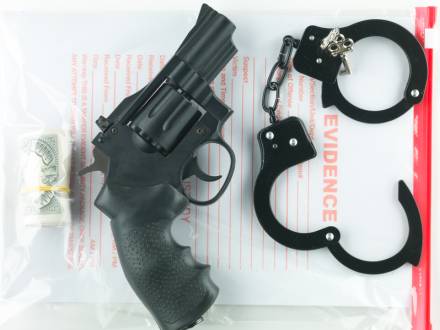
Possessing a regulated firearm after a violent crime conviction in Maryland can lead to up to 15 years in prison. A five-year minimum often applies, but an exception depends on when the earlier sentence ended. In 2026, Silver Spring, MD felony weapons crimes defense lawyers can review your case.
What Does Maryland Law Prohibit After a Violent Crime Conviction?
Under Maryland Public Safety § 5-133, someone previously convicted of a qualifying crime of violence cannot possess a regulated firearm. A regulated firearm includes a handgun and certain firearms classified as assault weapons.
The law also restricts possession after other convictions, including certain drug crimes. Penalties vary. Prosecutors must prove that you possessed the gun, that it counts as a regulated firearm under Maryland law, and that you had a prior conviction that bars you from possessing it.
Is a Five-Year Sentence Mandatory for Prohibited Firearm Possession in Maryland?
Under Maryland law, this felony carries up to 15 years in prison. The judge must impose at least five years unless an exception applies. When the minimum applies, the judge cannot suspend any part of it, and parole is usually unavailable during those five years.
There is an exception for older Maryland convictions. If you finished serving your most recent qualifying sentence more than five years before the new offense, the judge can impose less than five years. The calculation includes imprisonment, probation, parole, and mandatory supervision. In that situation, prosecutors must give written notice at least 30 days before trial to seek the minimum.
Which Maryland Convictions Count as Crimes of Violence for Firearm Charges?
Maryland Public Safety § 5-101 lists the offenses treated as crimes of violence for this law. Examples include murder, rape, robbery, carjacking, kidnapping, certain burglaries, and first- or second-degree assault. Some attempted offenses also qualify. The prior offense doesn’t have to involve a firearm. Out-of-state convictions can also qualify.
How Does Maryland Prove Someone Possessed a Prohibited Firearm?
Actual possession means physically holding or carrying a firearm. Constructive possession means you knew the gun was there and had some control over it, even if you weren’t holding it.
Finding a gun in a shared home or car does not prove that everyone there possessed it. Its location, fingerprints, statements, and access can matter.
A lawyer can challenge whether these facts establish knowledge and control. Possession can be shared, but prosecutors still need evidence linking each accused person to the gun. Mere presence at the scene is not enough.
What Defenses Can Be Used Against Maryland Prohibited-Firearm Charges?
A defense depends on what the State can prove. Common areas to examine include:
-
Whether police lawfully searched the home, car, or other location
-
Whether the accused knew about or controlled the firearm
-
Whether the prior conviction legally qualifies for the enhanced charge
-
Whether the item meets Maryland's definition of a regulated firearm
-
Whether witness statements and identification evidence are reliable
If police got evidence illegally, your lawyer can ask the judge to keep it out of court. The legality of a search depends on facts such as the warrant, consent, and any applicable exception. Your lawyer can also challenge whether the earlier conviction qualifies for the five-year minimum.
What Should You Do After a Prohibited-Firearm Arrest in Montgomery County?
Do not discuss ownership of the firearm or how it came to be in the location before getting legal advice. Do not delete messages or ask others to change their accounts of what happened.
Preserve any information about who had access to the car, home, or storage space. Ask your attorney to obtain the prior case judgment and relevant sentencing records. These can be essential to evaluating whether a mandatory minimum applies.
Can Maryland Firearm Rights Be Restored After a Violent Conviction?
For qualifying Maryland convictions, a pardon from the Governor can restore firearm rights only when the pardon expressly includes that relief. A pardon does not automatically erase the conviction or restore possession rights. Do not assume that finishing a sentence restores the right to possess a regulated firearm. Ask a Maryland lawyer to confirm eligibility before possessing a firearm.
Schedule a Free Consultation With Our Montgomery County, MD Weapons Crimes Defense Attorneys
If you face a Maryland firearm possession charge in 2026, early advice can help protect your rights. Our attorneys offer compassionate defense and answer calls 24 hours a day. We review searches, possession evidence, prior convictions, and sentencing exceptions. Our relationships with local prosecutors help us evaluate possible resolutions, while trial preparation remains important when the charges are disputed.
Contact The Law Offices of Gerstenfield & Demirji, PC. at 301-589-9500 to speak with our Silver Spring, MD felony weapons crimes defense lawyers today.
نتكلم العربية. Hablamos español.








For a free consultation, call 301-589-9500 or fill out the form below:
The Law Offices of Gerstenfield & Demirji, PC.
8720 Georgia Ave., Suite 301
Silver Spring, Maryland 20910
301-589-9500



